Canadian Intellectual Property Office experiencing backlog-related delays following recent public servant strike

The Canadian Intellectual Property Office (CIPO) experienced delays in the following areas during last month’s Public Service Alliance of Canada strike:

  • Fee processing;
  • Updating of the Patents Database;
  • Inaccurate automated correspondence due to delays in processing incoming correspondence;
  • Mailing of new examiner’s reports.

Although the strike was resolved on May 2, CIPO may continue to experience delays in these areas as it works through the backlog generated during the strike.

For CIPO’s announcement on the delays, please see here.

CIPO Releases Business Strategy

The Canadian Intellectual Property Office (“CIPO”) has released its business strategy for 2023-2028. CIPO’s three main priorities are:

  • Delivering quality IP services in a timely manner through operational excellence and a modern client experience;
  • Fostering innovation and competitiveness through leadership and education; and
  • Being a high-performing organization that is built for the future.

To read more about CIPO’s business strategy click here.

Patent Term Adjustment is on the Horizon in Canada

Amendments to the Patent Act introducing patent term adjustment have been tabled as part of Bill C-47 (Budget Implementation Act, 2023, No. 1), which received its first reading on 20 April 2023. Broadly, the proposed amendments in the bill, as currently contemplated, would allow patent term adjustment to account for delays during prosecution and would require that Applicants apply for patent term adjustment within three months of a patent being granted. Introduction of patent term adjustment comes as part of Canada fulfilling its obligations under the Canada-United States-Mexico Agreement. Looking ahead, the proposed amendments may be revised as the bill proceeds through Parliament and once the bill receives Royal Assent, the specific implementation of patent term adjustment would be set out in future regulations.

Click here to view the text of Bill C-47 and to track its progress.

Happy World Intellectual Property Day

Each year on April 26, we celebrate the World Intellectual Property Day. Established in 2000 by the World Intellectual Property Organization (WIPO), the World IP Day is meant to raise awareness of the need to advance innovation and to celebrate various forms of creativity and the contributions made by creators and innovators to global economic development.

This year the theme for the World Intellectual Property Day was “Women and IP: Accelerating Innovation and Creativity”.[1] In line with the theme, WIPO provided access to a number of resources to support and advance women’s participation in IP. Among those resources are IP Guides for Business designated to help small and medium-sized enterprises to understand the importance of IP. These guides can be accessed on WIPO’s website at https://www.wipo.int/publications/en/series/index.jsp?id=181.

Leading up to the World Intellectual Property Day, WIPO also organized the “Training, Mentoring and Matchmaking Program on Intellectual Property” for women entrepreneurs from Indigenous People and local communities. The program aimed to “encourage women entrepreneurship, innovation and creativity related to traditional knowledge and traditional cultural expressions”[2].

USPTO Commences Patent eGrants

The United States Patent and Trademark Office (USPTO) has begun issuing electronic patent grants (eGrants) for all patents as of 18 April 2023. The USPTO will no longer issue hardcopy paper patents by default. The new official statutory patent grant is the eGrant which will be accessible through the USPTO’s Patent Center. However, during a transition period the USPTO will provide ceremonial copies (i.e. paper copies of the electronic patent grant). After the transition period is over, such ceremonial copies will be available for purchase from the USPTO.

Read more here.

Federal Court dismisses appeal of refusal of TRIBAL CHOCOLATE trademark

The Applicant Tweak-D Inc. filed a trademark application for TRIBAL CHOCOLATE in connection with hair care products. The examiner objected to registration of the mark on the basis that it was confusing with the registered trademark TRIBAL for hair colourants and dyes. The Applicant commenced a section 45 proceeding seeking to expunge the TRIBAL mark, but discontinued the proceeding after reaching a co-existence agreement with the owner of the TRIBAL mark. The Applicant also agreed to amend the statement of goods in its application to restrict the channels of trade for its goods. The Applicant filed a revised application along with written submissions and a copy of the co-existence agreement, but the examiner maintained the objection and refused the application.

At the time the TRIBAL mark was registered, there were two other registered trademarks for personal care products that included the word TRIBE or TRIBAL: TRIBAL INDULGENCES and URBAN:TRIBE. On appeal, the Applicant argued that there was an apparent inconsistency in allowing registration of the TRIBAL mark given the previous registration of TRIBAL INDULGENCES, and on the other hand refusing the Applicant’s TRIBAL CHOCOLATE application in light of the TRIBAL registration.

As part of its confusion analysis, the examiner observed that the state of the register evidence did not reveal a “clear pattern of registrability” of marks similar to TRIBAL CHOCOLATE or TRIBAL. The Court inferred that the examiner was referring to cases which have found state of the register evidence particularly compelling, but have generally involved far more than three relevant registrations.

The Court found the examiner made no overriding and palpable error, and the appeal was dismissed.

Read the full decision here:

https://www.canlii.org/en/ca/fct/doc/2023/2023fc427/2023fc427.html

DABUS Saga Continues: Loss for Dr. Stephen Thaler In New Zealand Appeal

DABUS, short for Device for the Autonomous Bootstrapping of Unified Sentience, has suffered another court loss in it’s creator’s quest for it to be recognized as an inventor by the world’s patent offices. Dr. Stephen Thaler, the creator of DABUS, filed patent applications in several national patent offices naming DABUS as the sole inventor. Dr. Thaler’s applications were denied in several cases and Dr. Thaler appealed to courts in multiple jurisdictions. Dr. Thaler has since had successes in South Africa and Australia and losses in the United Kingdom and the United States of America.

Most recently, a judgment was issued from the High Court of New Zealand in which Palmer J. dismissed Dr. Thaler’s appeal from the decision of the Assistant Commissioner of Patents. The judgment assessed whether the definition of inventor under New Zealand law requires the inventor to be a natural person. Palmer J. indicated that a “natural reading of the section suggests the inventor is a person”. After discussing the legislative context and legislative history of the New Zealand Patents Act 2013, Palmer J concluded that, while the law did not explicitly require that an inventor is a person, it still appeared to be the intent of Parliament that inventors be natural persons. Palmer J. further stated that it would not be appropriate for the courts to expand the definition of inventor through statutory interpretation, but that such an expansion should be effected by Parliament, explicitly, if that was their intent.

For our previous commentary on the DABUS Saga, see here and here.

For the full text of the High Court of New Zealand judgment, see here.

Sweetgreen renames new chipotle chicken menu item after lawsuit from Chipotle

The salad chain Sweetgreen has decided to rename its new chipotle chicken menu item, just two days after fast food giant Chipotle Mexican Grill, Inc. filed a lawsuit alleging trademark infringement over the previously named new menu item “Chipotle Chicken Burrito Bowl”.

Sweetgreen has reached a tentative agreement with Chipotle to resolve the lawsuit. One part of the agreement is to rename its new bowl to “Chicken + Chipotle Pepper Bowl”, exactly one week after the original announcement of the new bowl.

In its lawsuit, Chipotle claimed that Sweetgreen is trying to create a false association with Chipotle by making prominent use of its famous Chipotle trademark in a font near identical to Chipotle’s stylized logo as well as featuring a background that is nearly identical to Chipotle’s trademarked Adobo Red color in the advertisements.

See the full articles here.

NPR article: https://www.npr.org/2023/04/05/1168277607/chipotle-sweetgreen-chicken-burrito-bowl-lawsuit   

CNBC article: https://www.cnbc.com/2023/04/05/chipotle-sues-sweetgreen-for-burrito-bowl-trademark-infringement.html

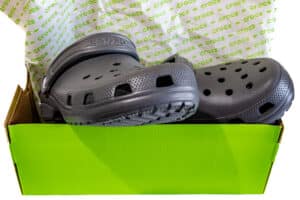
Crocs evolves from a boating shoe to Brand of the Year and defends its brand


Crocs are, as many know, foam clogs.  Initially developed as a boating shoe, Crocs were launched in 2001 at a boat show in Florida[1] and quickly became a great success, selling all of the shoes at the boat show and going on to sell over 850 million pairs of shoes around the world[2].  In 2020 they were named Footwear News’s Brand of the Year[3].  In order to protect their intellectual property against the flood of copycats that would inevitably follow such success, Crocs has secured trademark registrations in countries around the world, including Canada, for the word CROCS, for several related word and design marks and for the three-dimensional shape of the shoe.

Crocs has also obtained a number of utility and design patents.  Crocs made headlines in September 2019 when the U.S. Patent and Trademark Office’s Patent Trial and Appeal Board held that the design patent for the Classic Crocs clog was valid, despite opposition from one of Crocs’ major competitors, U.S.A. Dawgs.  Crocs had first sued U.S.A. Dawgs for patent infringement in 2012, after filing a lawsuit against U.S.A. Dawgs’ Canadian affiliate in 2006, and finally won its case in July 2022.[4]

In 2017, the legal battle between Crocs and USA Dawgs extended into Canada, when Crocs Canada sued Canada Dawgs, claiming infringement of their Industrial Design Number 120939 entitled SHOE (939 Design).  As expected, Dawgs filed a Counterclaim challenging the validity of the 939 Design.  In a decision issued on 21 October 2022, The Honourable Justice Fuhrer of the Federal Court of Canada found that Croc’s 939 Design was valid and that Dawgs infringed it[5], awarding Crocs an accounting of Dawg’s profits in the amount of $649,779.17. In addition, Crocs was awarded costs of $232,861.15 plus interest.[6]

In June 2021, Crocs filed a complaint with the United States International Trade Commission (ITC) requesting an investigation of unlawfully imported shoes that allegedly violate its registered trademarks, consisting of the three-dimensional shape of the shoe.  Prior to that, in 2006 Crocs filed a request with the ITC to investigate the importation of footwear that would infringe the design and utility patent rights for their clogs.  This resulted in a July 2011 general exclusion order prohibiting the importation of products that infringed Crocs’ utility and design patents[7].

In July 2021, Crocs commenced lawsuits against 21 companies, including Walmart Inc., Loeffler Randall Inc. and Hobby Lobby Stores Inc.  Some of these lawsuits have since been settled, the most recent one being a settlement with Walmart this month.

More recently, in June 2022, Crocs commenced a lawsuit against Daiso accusing them of manufacturing and selling knock-off versions of its clog.  It remains to be seen if this will result in a settlement as with the other cases, but regardless of the amicable resolution of many of these cases, Crocs has stated that it “will continue to aggressively protect its trademarks and other intellectual property rights in the Crocs brand”[8], and appears to be set to do so.


[1] https://en.wikipedia.org/wiki/Crocs
[2] https://careers.crocs.com/about-us/default.aspx
[3] https://footwearnews.com/2020/business/awards/crocs-fnma-2020-brand-year-1203081005/
[4] https://footwearnews.com/2022/business/uncategorized/crocs-wins-legal-patent-battle-usa-dawgs-1203311492/
[5] https://www.canlii.org/en/ca/fct/doc/2022/2022fc1443/2022fc1443.html
[6] https://canlii.ca/t/jvfx0
[7] https://www.lexology.com/library/detail.aspx?g=d0d2c1e3-a167-4fac-bdc6-ddc579564c01

[8] https://footwearnews.com/2022/business/legal-news/crocs-settles-trademark-infringement-suit-walmart-1203339710/


US Copyright Office says Works Containing AI-Generated Content can Obtain Copyright Protection…Sometimes

The US Copyright Office (“USCO”) has issued a policy statement for guidance on the copyright registrability of works containing AI-generated content. The policy statement is effective 16 March 2023. The issuance of the policy statement follows the USCO’s decision in February to limit the copyright registration of a comic book that contained AI-generated images.

In its policy statement, the USCO reiterates that copyright registration requires human authorship. According to the USCO, a work where AI acts as an assisting instrument can be registered whereas a work where AI conceives and executes the traditional elements of authorship cannot be registered. When an AI technology generates complex written, visual, or musical work in response to a prompt input by a human, that work cannot be registered. However, an AI-generated work with sufficient human authorship can be registered. For example, an AI-generated work that is modified by an artist may be registered depending on the degree of modification.

The USCO has also stated that a copyright registration applicant has a duty to disclose the inclusion of AI-generated content in any work that is submit for registration. If the applicant has used AI to create the work, the applicant must specify what parts of the work were contributed by human authorship. The applicant should exclude from the registration application any AI-generated content that is more than de minimis.

The duty to disclose the inclusion of AI-generated content in works submitted for registration extends to pending applications and applications that have been processed and resulted in a registration.

For more information, see here.

For the full text of the USCO’s policy statement, see here.

get_sidebar();